
Don’t worry, it’s not rhetorical. We put that exact question at the front of our survey of 100 New Orleans area locals, and it doubled as the bouncer. Answer August and you were out of the survey, no hard feelings, enjoy your 0% below. The people who passed settled a debate this city has been having over propane burners forever:
Figure 01 · The cold open
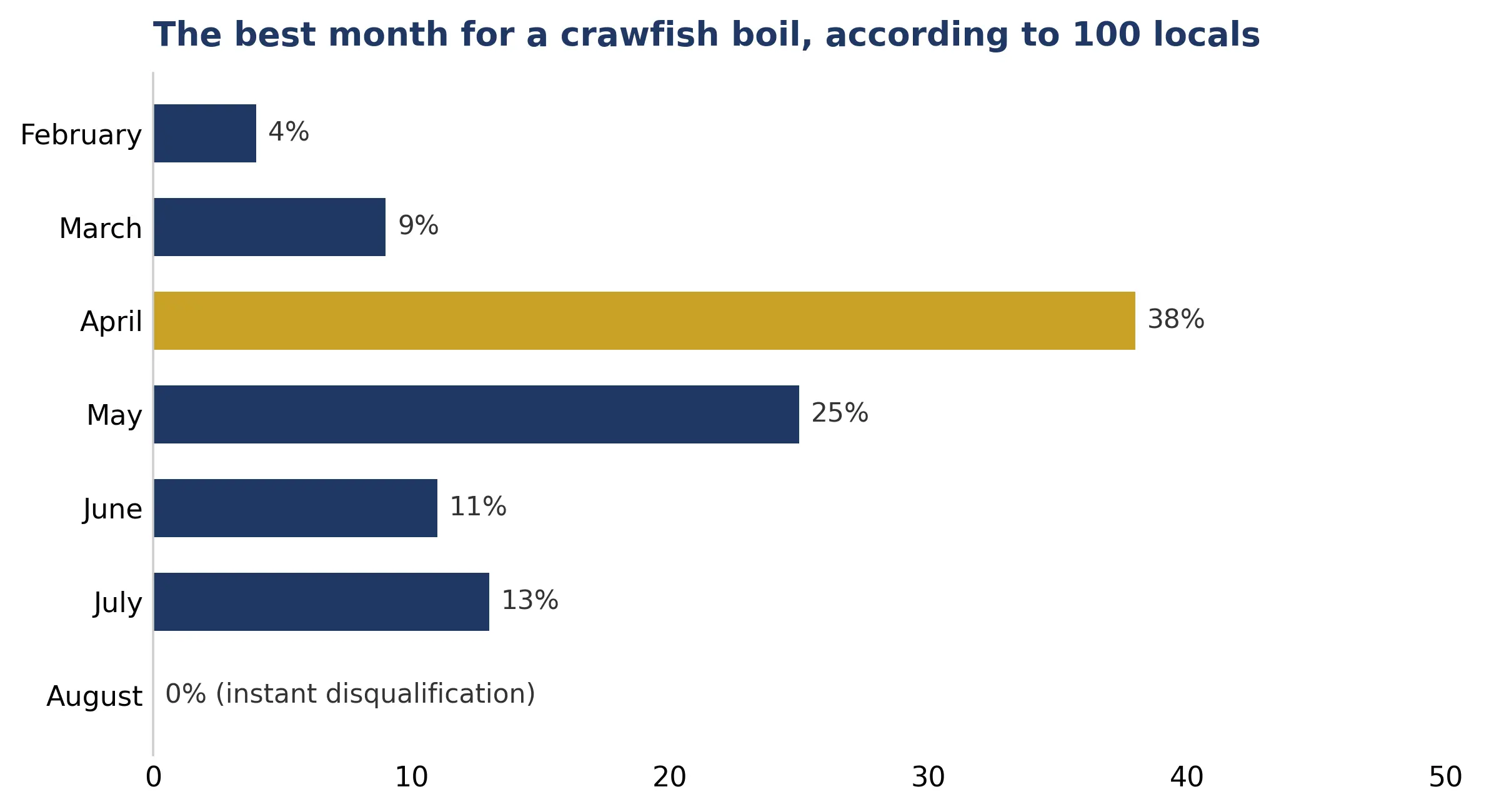
April. And it isn’t close. 38% of locals crowned it, May took second at 25%, and together that’s nearly two-thirds of the city telling you when peak boil season hits. The 13% who said July are the Fourth of July loyalists, and we respect the commitment to sweating over a burner in midsummer. So why open a moving guide with crawfish? Because that’s the kind of guide this is. Every number in it comes from people who know the answer cold, and it only gets more useful from here.
Thinking about moving to New Orleans in 2026? Here’s the short version. You’re signing up for one of America’s great food, music, and festival cities, and 81% of the locals we surveyed put the food among the best things about living in New Orleans. You’re also signing up for serious heat, hurricane season, quirky infrastructure, and insurance bills that surprise almost everyone. The best guide tells you both. That’s this one.
Most moving-to-New-Orleans guides are written by someone who spent a long weekend in the French Quarter. We went a different way. In September 2026, we surveyed 100 people who actually live here, spread across New Orleans proper, Metairie, Kenner, the West Bank, the Northshore, and the parishes around them. Two-thirds grew up here. More than 80% have lived here over 15 years. What you’re about to read is their honest take on living in New Orleans, the city they love and complain about in the same breath, with every chart built straight from their answers. Grab a coffee, or a daiquiri, we don’t judge. Let’s get you moved.
Is New Orleans a Good Place to Live in 2026?
Yes, according to the people who’d know. 57% of locals would recommend moving here. A third said “definitely yes,” and only 3% said “definitely not.” Another 29% gave us the most New Orleans answer possible: “it depends.” Fair. It does.
Figure 02
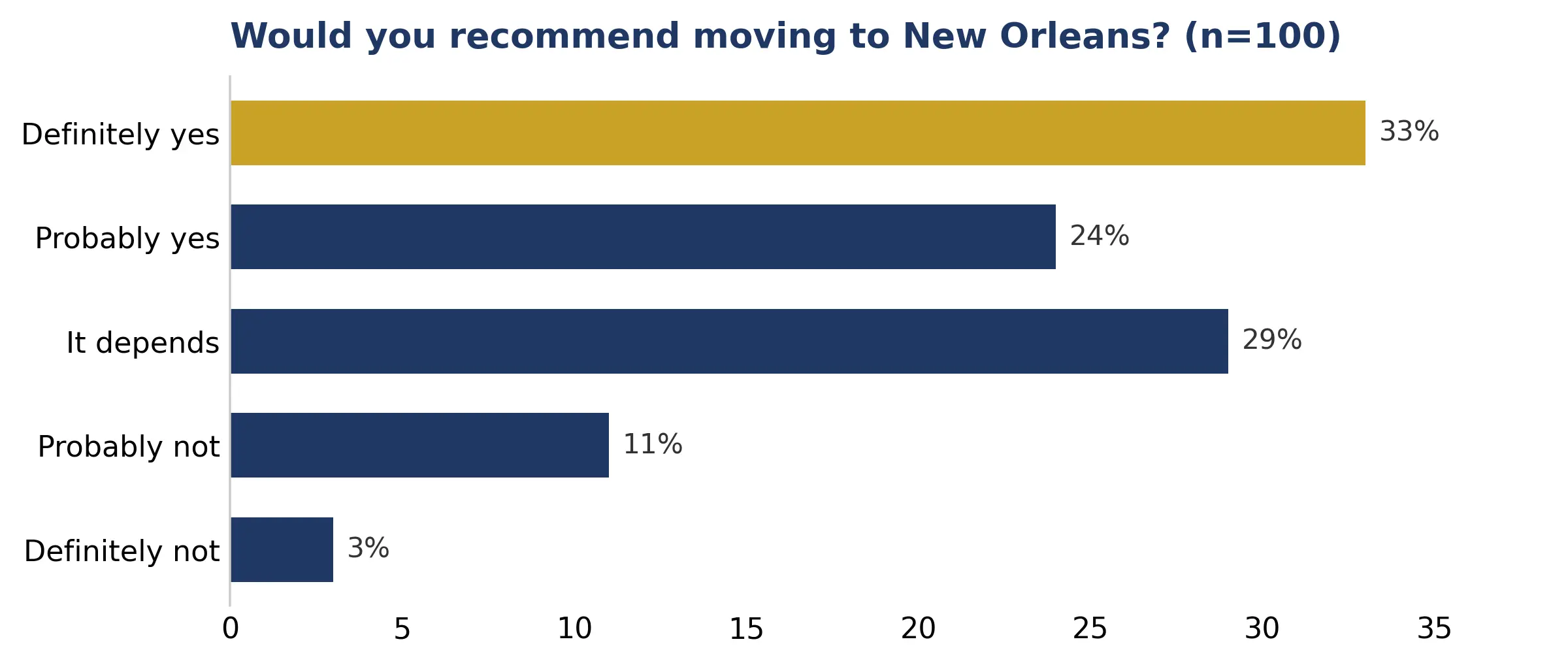
Here’s the part we love. Transplants recommend the city at almost the same rate as lifelong locals, 56% to 58%. City residents match the suburbs, 59% to 56%. The people who chose New Orleans and the people who were born into it landed in the same place. That tells you the city delivers on its promises, as long as you know what those promises are. And aren’t. Keep reading.
Pros of Moving to New Orleans
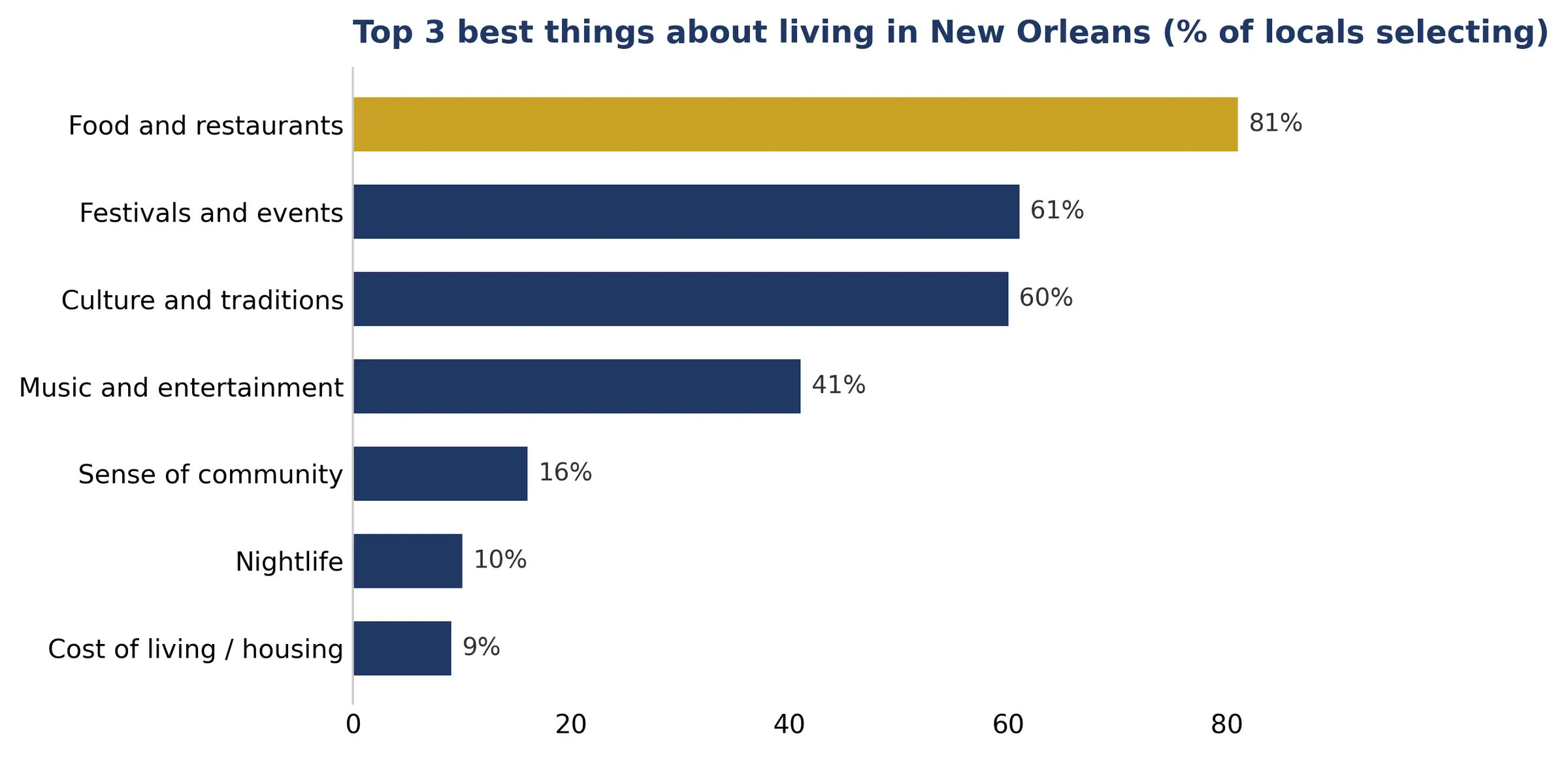
We asked locals for the top three best things about living here. They didn’t hesitate, and they didn’t say anything about money.
Figure 03
Culture and Food
Food and restaurants (81%), festivals and events (61%), and culture and traditions (60%) ran away with it. Music came in right behind at 41%. No other American city produces numbers like these, and honestly, no other city could. The culture here isn’t a weekend amenity. It’s the operating system. Almost a third of locals told us that festivals being part of everyday life was one of the biggest surprises of living here. One respondent summed up the whole city in one line:
“It is really like no other city on earth. It’s all the best and worst rolled into one.”
Frame that.
Housing Options
Your housing dollar genuinely stretches further here. In August 2026, the median New Orleans home sold for $339,775, about 14% below the national median, according to Redfin. Zillow’s numbers back that up, showing a median sale price around $333,000 and an average rent of $1,637 a month, versus $1,948 nationally. Want the longer view? Census figures for 2020 to 2024 put the city’s median owner-occupied home value at $315,700 and median gross rent at $1,251, both under the national benchmarks of $332,700 and $1,413. So the discount is real, and it isn’t new.
But notice something in that chart above: only 9% of locals named cost of living among the best things about living here. Nobody sells this city on price, and there’s a reason. It’s called insurance, and we’ll get there.
Sources: Redfin: New Orleans Housing Market · Zillow: New Orleans Home Values & Rentals · U.S. Census QuickFacts: New Orleans · U.S. Census QuickFacts: United States
Walkability
The city is flat as a beignet, and the numbers back up the payoff. The Marigny posts a Walk Score of 96, Uptown scores 88, and Mid-City comes in at 81, which puts all three in Walk Score’s “Very Walkable” or “Walker’s Paradise” territory. Cyclists do even better: Mid-City earns a 94 Bike Score and the Marigny a 92.
The streetcars are real transit too, not just something pretty for postcards. The RTA runs five lines: St. Charles, Rampart/Loyola, Canal-Cemeteries, Canal-City Park, and Riverfront, connecting Uptown, Mid-City, and downtown. Still, walkability varies sharply across the city. The citywide average Walk Score is 58, so whether you can comfortably skip the car depends heavily on your neighborhood and your commute.
Cons of Moving to New Orleans
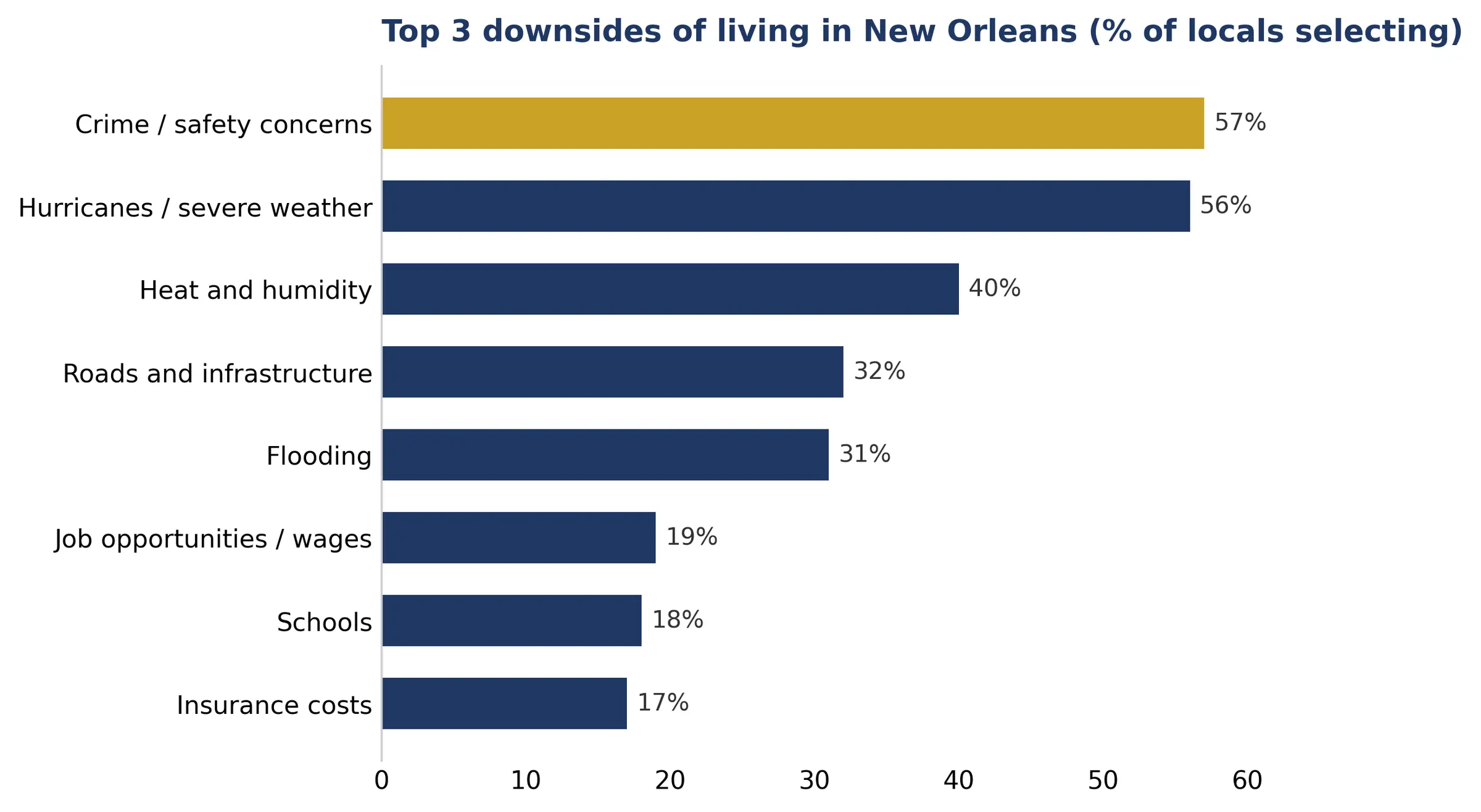
We promised honesty, and locals delivered it. Their top two downsides finished one point apart.
Figure 04
Weather and Climate
56% put hurricanes and severe weather in their top three downsides. 40% said the heat. 31% said flooding. We gave weather its own full section later in this guide because locals basically demanded it. Wait until you see what they said about summer.
Crime and Safety
We’re not going to dance around it. Crime was the single most-named downside at 57%, one point ahead of hurricanes. But our survey caught something the headlines miss, and it’s one of the most interesting findings in the whole project. The worry splits sharply depending on where you live. We’ll show you that chart in the city-versus-suburbs section, and it might change how you read the news. It’s also why locals rank safety as the #1 factor in picking a neighborhood, and why their standard advice is to rent first.
Now the context the headlines keep missing: the trend line is pointing hard in the right direction. As of September 20, 2026, the Metropolitan Crime Commission reported 60 homicide victims year to date, 36% fewer than at the same point in 2025 and 72% fewer than in 2022. Across homicide, nonfatal shootings, carjackings, and armed robberies, reported incidents were down 70% compared with 2022. That doesn’t erase anyone’s concern, and it shouldn’t. But if your mental picture of New Orleans crime was formed in 2022, it’s out of date.
Infrastructure
The potholes are a citywide running joke with a very real repair bill. 32% of locals put roads and infrastructure in their top downsides, and 33% said road conditions were one of the biggest surprises of living here. “I wish somebody had warned me how bad the roads are,” one respondent told us. Another gave advice we’d tattoo on every lease:
“Learn what streets flood in a heavy rain.”
Cost Surprises
Now the stat every relocation guide should lead with. We asked which costs newcomers underestimate the most, and the top four answers were all insurance and disaster costs. All four. Ahead of rent. Ahead of taxes. Ahead of groceries.
Figure 05
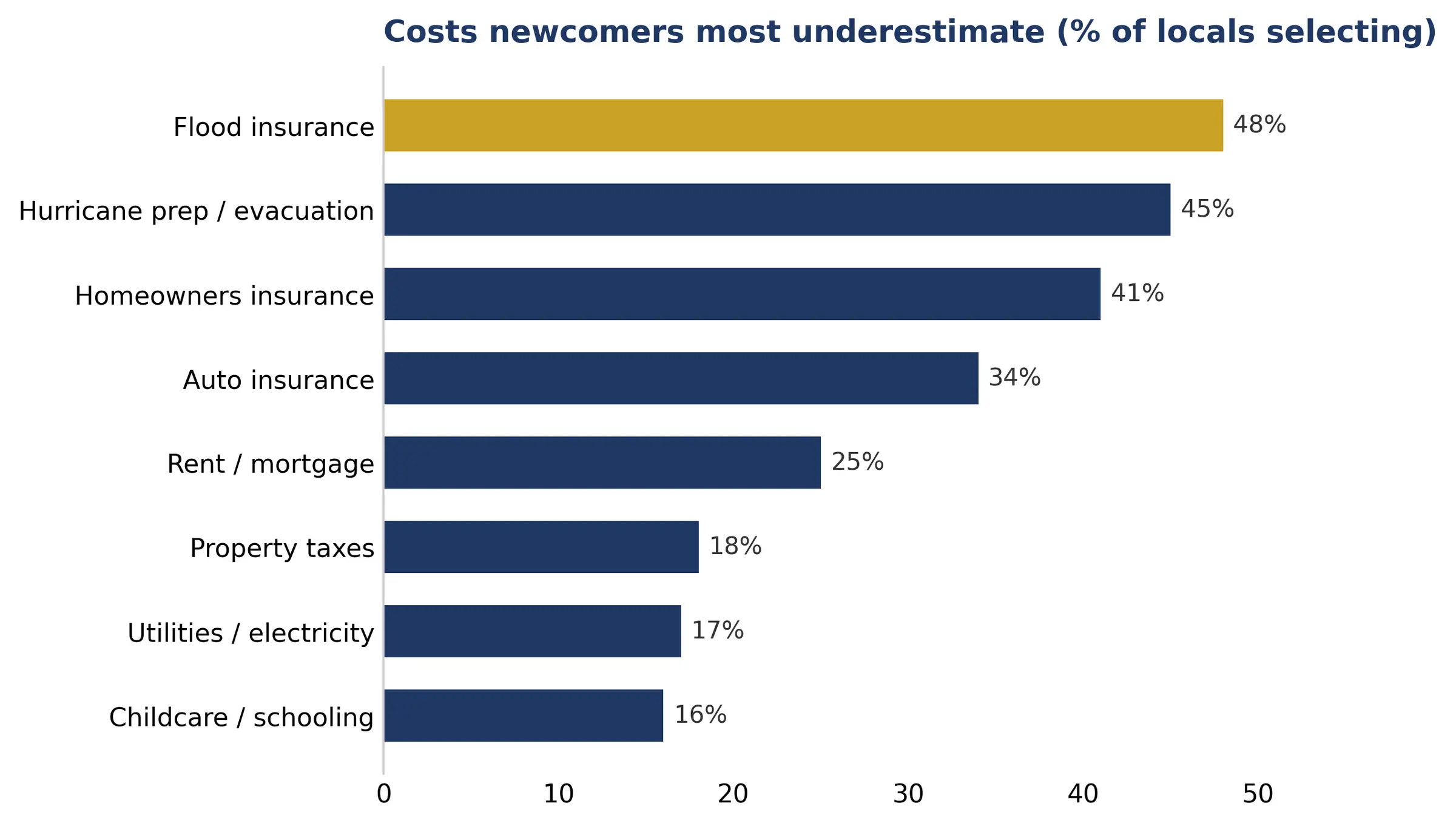
Flood insurance (48%), hurricane prep and evacuation (45%), homeowners insurance (41%), and auto insurance (34%). Louisiana’s insurance market is the hidden line item in every New Orleans budget, and locals know it better than any cost-of-living calculator you’ll find online. Get quotes before you sign anything. Seriously.
The numbers explain why. The latest state-by-state homeowners data from the Insurance Information Institute, based on 2022 NAIC figures, puts Louisiana’s average HO-3 homeowners premium at $2,603 a year versus $1,569 nationally. That’s about 66% higher, and the second most expensive in the country. Flood insurance is a separate policy on top of that, and FEMA prices it property by property based on location, construction, and coverage. One FEMA-data-based analysis puts the average NFIP policy in New Orleans around $774 a year, but your exact address is what counts, so get a real quote. Auto runs high too: the latest NAIC expenditure data shows Louisiana drivers spending $1,754 per insured vehicle versus $1,282 nationally, roughly 37% more.
One piece of genuinely good news: the market is finally bending. The Louisiana Department of Insurance reported that private-passenger auto premiums fell an average of 5.8% statewide in 2025, and homeowners rates, while still rising, climbed at their slowest pace in years. Shop around. The state insurance department is literally telling people to.
Cost of Living in New Orleans
Ask 100 locals if New Orleans is affordable and you don’t get an answer, you get a bell curve. Which is honestly the right answer, because it depends enormously on your address, your flood zone, and your insurance.
Figure 06
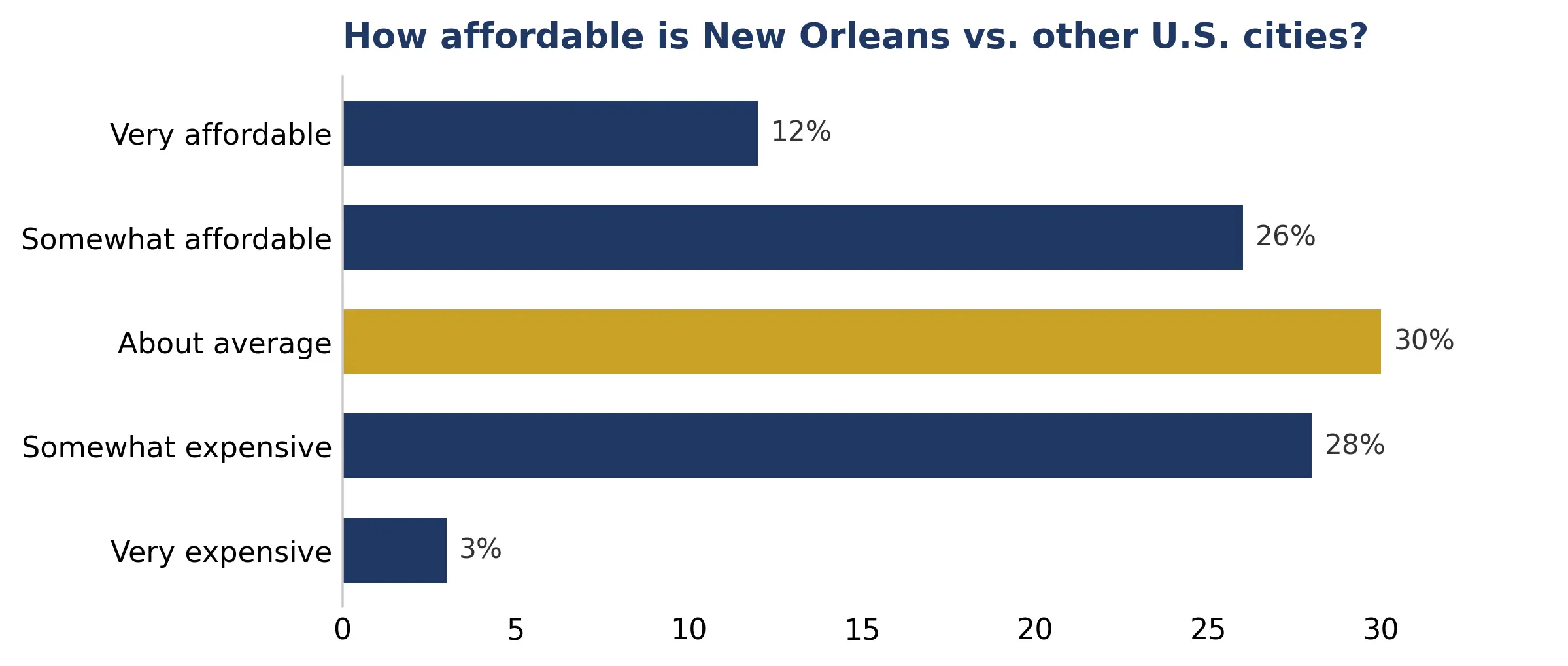
38% call the area affordable compared with other U.S. cities. 30% say it’s about average. 31% say it’s expensive. Here’s how to read that: some everyday costs sit right at national norms. Groceries, for example, index at 99.2 against a U.S. urban average of 100. The structural stuff is where budgets move fast: housing, insurance, summer utilities, and for families, schooling. Here’s the snapshot:
| Expense | New Orleans Benchmark | Source / Date |
|---|---|---|
| HUD Fair Market Rent — 1 bedroom | $1,113/mo. | HUD, FY2026 |
| HUD Fair Market Rent — 2 bedrooms | $1,331/mo. | HUD, FY2026 |
| Median home sale price | $339,775 | Redfin, Aug. 2026 |
| Average Entergy electric bill | $157.26/mo. | EIA, June 2026 |
| Peak-summer Entergy benchmark | ~$191/mo. | EIA, July–Aug. 2025 average |
| Grocery index | 99.2 (U.S. urban avg. = 100) | C2ER, 2025 annual average |
So the picture is more complicated than calling New Orleans cheap or expensive. Rents and home prices compare favorably with plenty of big U.S. markets, and groceries sit right at the national urban average. But the costs that matter most here, especially homeowners, flood, and auto insurance, can rewrite a household budget fast.
And about those utilities. 53% of locals listed “embrace air conditioning (and budget for the summer electric bill)” among their top heat strategies, and the meter backs them up. Entergy New Orleans customers averaged $157.26 in June 2026, and in the most recent complete peak-summer data, bills averaged about $191 a month in July and August 2025, versus roughly $97 in November. The budgeting half of their answer is not a joke.
Sources: HUD: FY2026 Fair Market Rents · Redfin: New Orleans Housing Market · EIA data via Energy Factbook: Entergy New Orleans · C2ER data via McNeese Drew Center
How Much Should You Save Before Moving to New Orleans?
We asked point blank: how much should a single adult have saved before moving here without a job lined up?
Figure 07
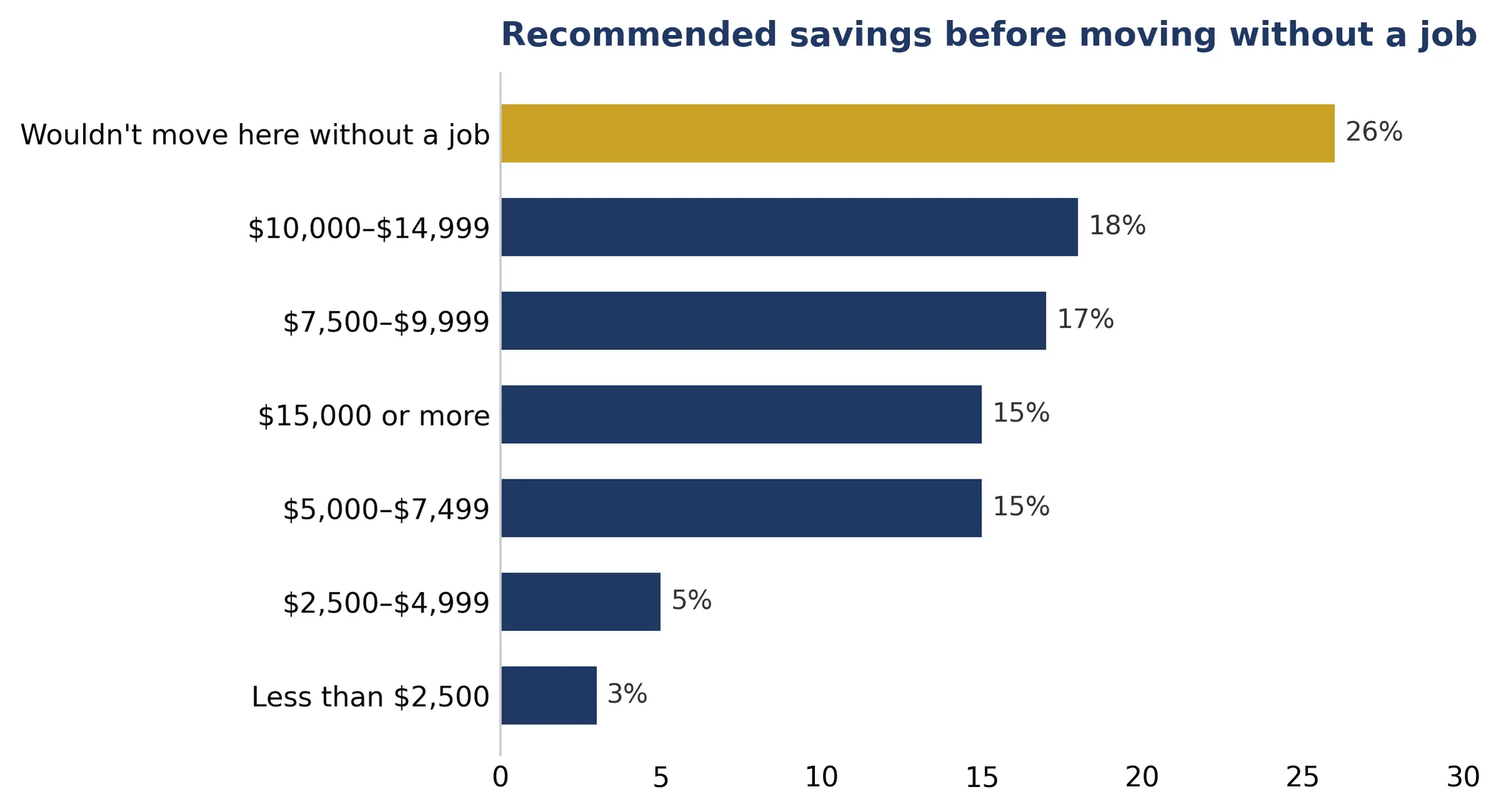
26% said don’t do it at all. More than one in four locals wouldn’t recommend moving here without a job. Among those who gave a number, the median landed in the $7,500 to $9,999 range, and 45% said $10,000 or more. One more wrinkle we found in the data: lifelong locals are more cautious than transplants. 29% of natives said don’t come jobless, versus 21% of the people who actually made the move themselves. Take the hint from the folks who did it.
Best Neighborhoods in New Orleans (2026)
We didn’t ask locals to crown the best neighborhood in New Orleans. There isn’t one, and anyone who tells you otherwise is selling a listing. We asked two smarter questions instead: what should you prioritize when choosing, and where should a newcomer look first?
What Locals Say to Prioritize
Figure 08
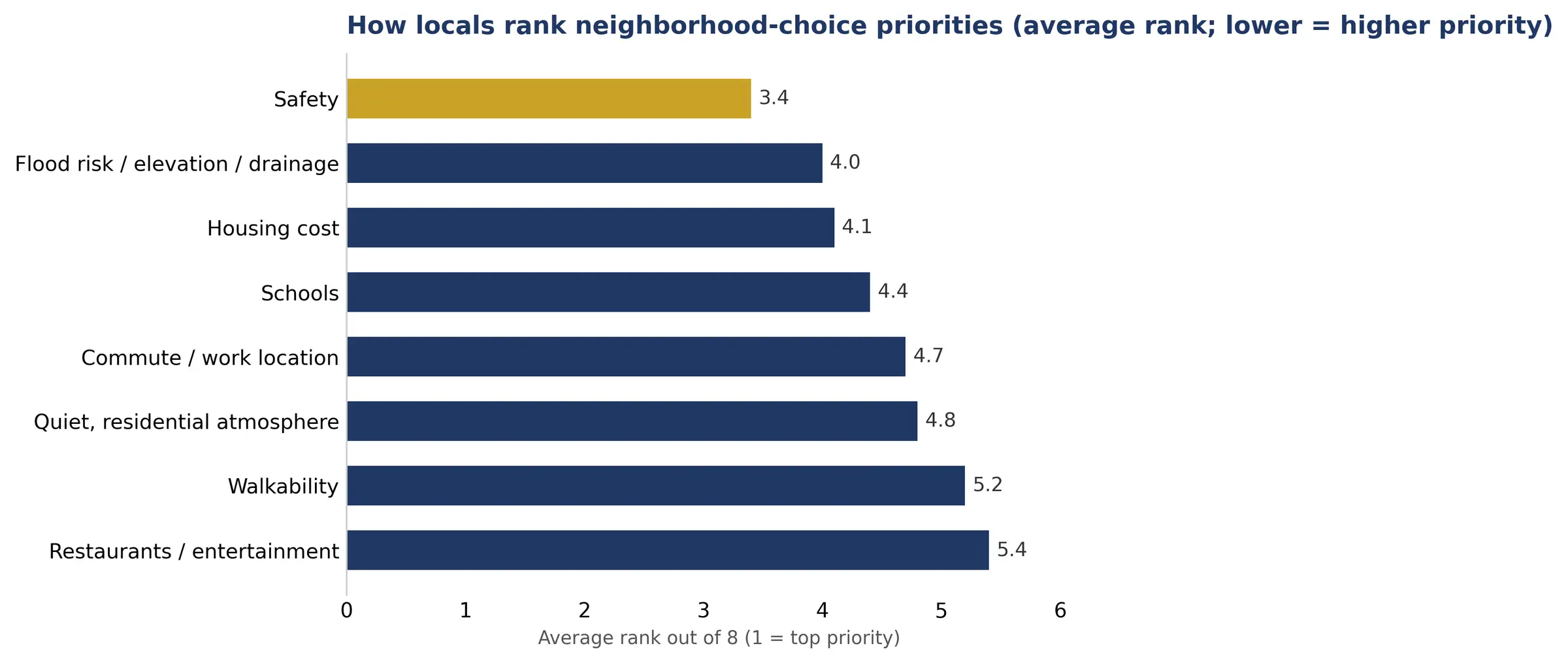
Locals ranked eight factors, and the podium reads: safety first, flood risk second, housing cost third. Look at that order again. Flood risk beats price. In New Orleans, elevation is a real estate metric, and locals check the flood map before the listing photos. You should too. It’s the most local thing you’ll ever do.
Where Locals Tell Newcomers to Look First
Figure 09
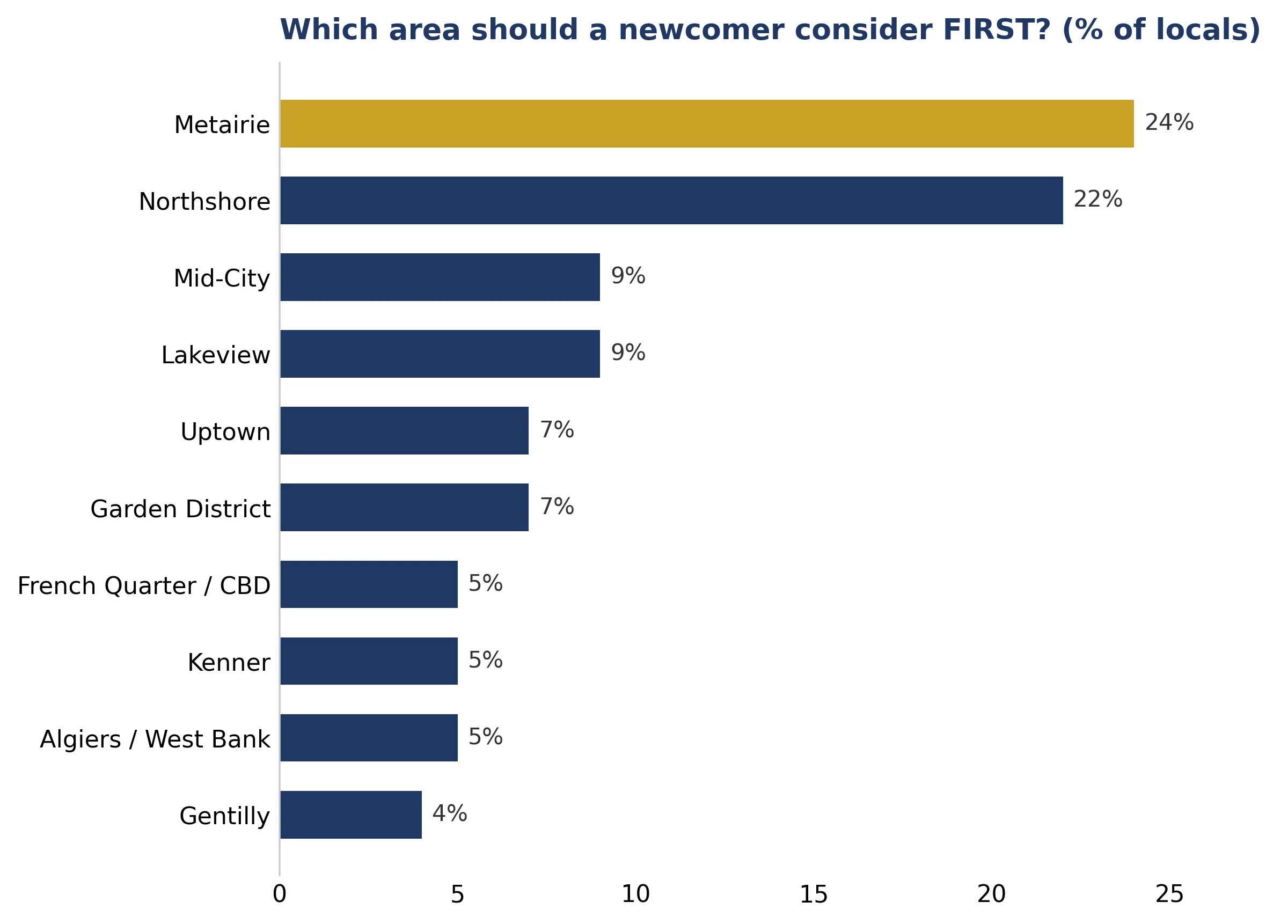
Metairie (24%) and the Northshore (22%) topped the list. Add them up and nearly half of locals point newcomers to the suburbs before the city. Inside New Orleans proper, Mid-City and Lakeview led at 9% each, with Uptown and the Garden District at 7%. And no, that’s not locals trash-talking their own city. It’s locals handing you an easier landing while you learn the terrain: the flood maps, the block-by-block quirks, the commute math. You can always move into the city once you speak fluent New Orleans.
Neighborhoods by Who They’re Best For
- Families: Metairie, Lakeview, and the Northshore. You’ll see the full family ranking in the next section, where these three swept the podium.
- Young professionals and culture-first movers: Uptown, Mid-City, and the Marigny/Bywater. That’s the walkable, music-soaked version of the city, with the price tags and block-by-block variance to match.
- First-time renters getting oriented: Mid-City and Lakeview. Mid-City is central with streetcar access, Lakeview is quieter and residential, and locals recommended both first for a reason.
- Commuters and budget-watchers: Kenner, the West Bank, and greater Jefferson Parish offer a more suburban pattern than the historic core, with current median listing prices below several of the central New Orleans neighborhoods in the table below.
And because “it’s cute” isn’t a budget, here’s what these areas actually cost right now. All figures are median listing prices and median rents from Realtor.com Economic Research, August 2026.
| Area | What It’s Like | Median Listing Price | Median Rent |
|---|---|---|---|
| Metairie | Suburban Jefferson Parish, right next to the city | $334,500 | $1,700/mo. |
| Lakeview | Residential, near City Park and the lakefront | $555,725 | $1,900/mo. |
| Northshore (Mandeville–Covington)* | Suburban communities across the causeway | ~$399K–$406K | ~$1,980–$2,100/mo. |
| Uptown & Carrollton | Historic streets, the universities, Magazine and Oak | $411,500 | $1,800/mo. |
| Mid-City | Central and residential, streetcar and Greenway access | $418,750 | $1,500/mo. |
| Marigny / Bywater | Historic, music and arts, next door to the Quarter | ~$365K–$399K | ~$1,650–$1,700/mo. |
| Kenner | Suburban Jefferson Parish, west, near the airport | $287,500 | $1,575/mo. |
| Algiers (West Bank example) | Quiet and residential, across the river from downtown | $265,450 | $1,575/mo. |
| Jefferson Parish overall | Broad parish-wide benchmark | $288,475 | $1,600/mo. |
*The Northshore is a region, not one market, so we’re using Mandeville and Covington as representative examples. And notice something: the suburbs aren’t automatically the budget play. Popular Northshore communities list around $400K with rents near $2,000. Locals recommend them for the lifestyle, not the discount.
Moving to New Orleans With a Family
We asked locals to rank eight areas specifically as places to raise a family. The suburbs and the lakefront didn’t just win. They swept.
Figure 10
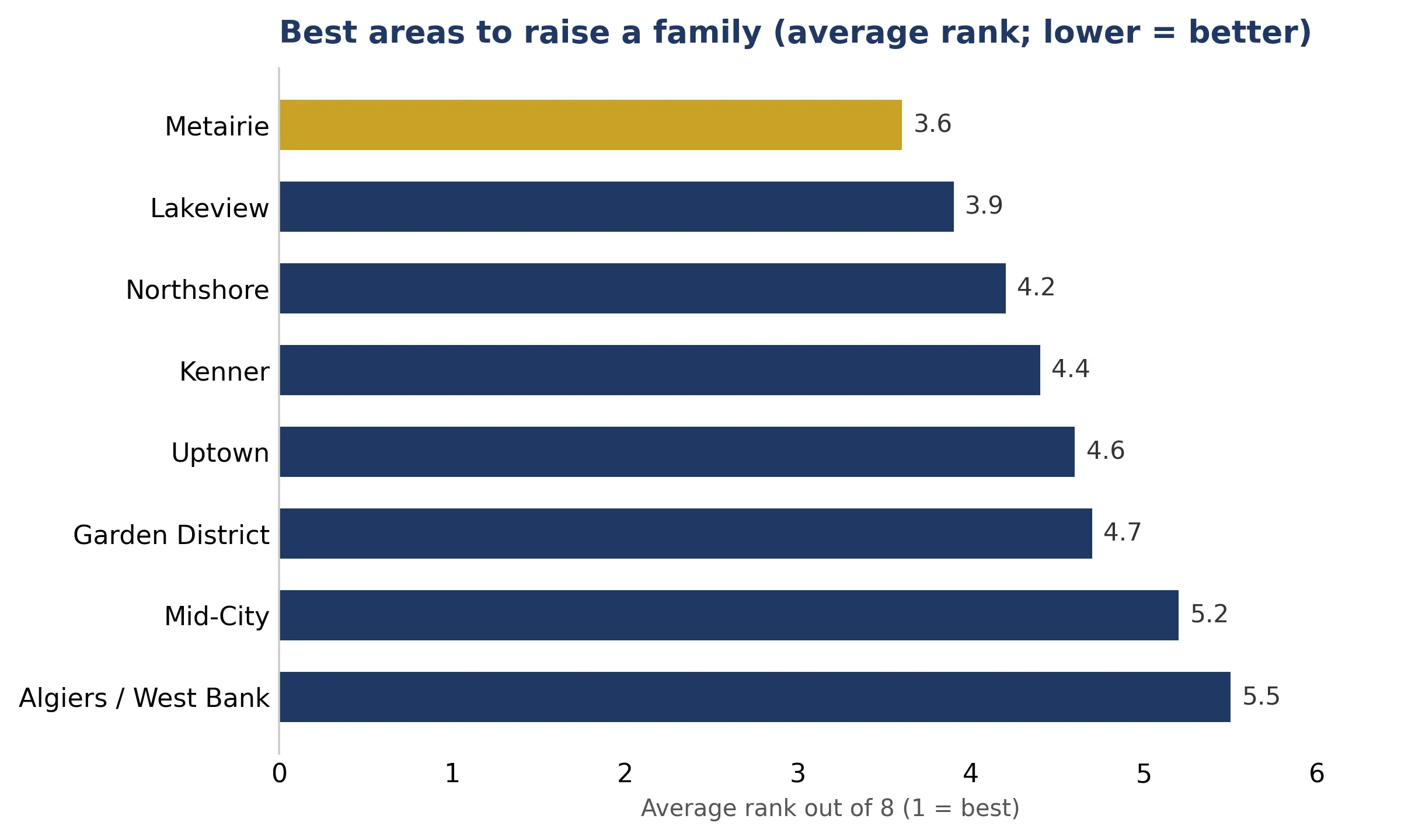
Metairie took the best overall average. Lakeview came second. The Northshore grabbed the most first-place votes, with 26% of locals ranking it #1 outright. The pattern matches everything else in this data: when kids enter the picture, locals prioritize schools, drainage, and yards over walkability and nightlife. Shocking, we know.
Now the honest asterisk: schools. 18% of locals named them a top downside, and the write-in answers got specific. “Check the school districts before buying a home,” one respondent said. Another wished they’d known “how much money I would end up spending on private school for my kids.” The public-charter landscape here is complicated and it changes school by school. Research individual schools the same way you’d research flood zones, because locals treat both as address-level decisions.
Moving for college? The university corridor of Tulane, Loyola, Xavier, and UNO brings in thousands of people a year, and each campus points to a different neighborhood search. Tulane and Loyola mean Uptown and the Garden District. UNO means Gentilly and Lakeview.
Moving to New Orleans for Work
We asked locals to name the area’s top employers, and they pointed hard in one direction: healthcare.
Figure 11
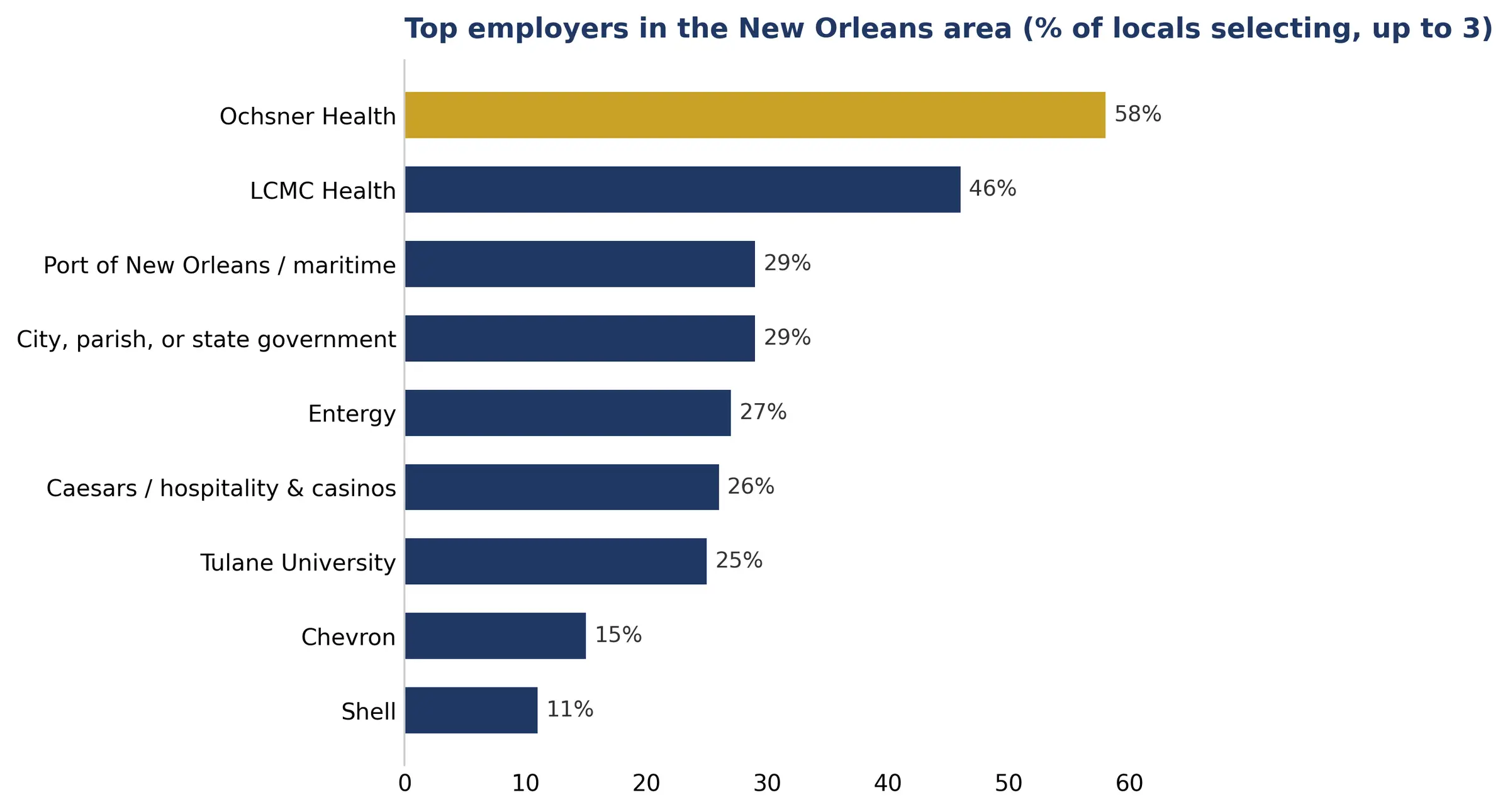
Ochsner Health (58%) and LCMC Health (46%) led by a mile, with the Port of New Orleans, government, Entergy, Caesars and the hospitality world, and Tulane rounding out the list. The career picture matches:
Figure 12
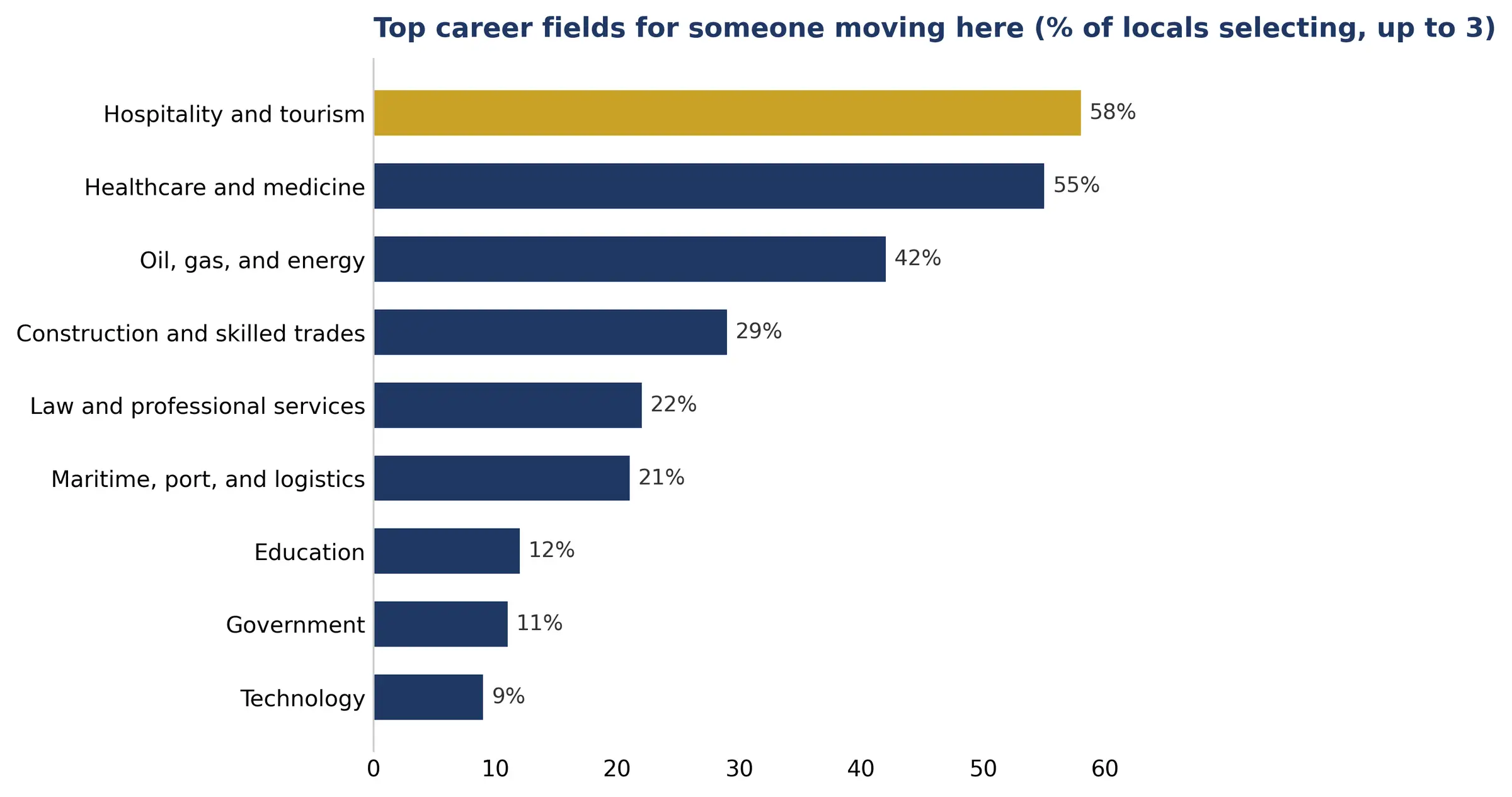
Hospitality and tourism (58%) and healthcare (55%) are where locals say the opportunity lives, with oil and gas (42%) and the skilled trades (29%) behind them. Technology got 9%. New Orleans isn’t pretending to be Austin, and locals aren’t pretending either. We respect it.
One dose of local realism before you pack: 19% named jobs and wages a top downside, and one respondent didn’t sugarcoat it.
“Hard to find a job and there is a lot of competition with locals.”
That’s a big part of why a quarter of locals say don’t move here without work lined up.
Current federal data backs up what locals told us. The New Orleans-Metairie metro’s unemployment rate was 4.5% in July 2026 (preliminary), per the Bureau of Labor Statistics. Wages trail the national benchmark, though: the latest BLS occupational survey, covering May 2025 and released in August 2026, puts the metro’s average wage at $29.35 an hour versus $33.54 nationally, about 12.5% lower. The employment mix tells the same story the survey did. Food prep and serving jobs make up 11.3% of local employment versus 8.8% nationally. Healthcare practitioners come in at 7.8% versus 6.3%. And computer and math jobs? Just 1.6% locally versus 3.4% nationwide, which is the federal-data version of that 9% technology answer.
Living in New Orleans vs. Living in the Suburbs
Our respondents came from all over the metro. 22% live in New Orleans proper, 21% on the West Bank, 19% on the Northshore, and the rest across Metairie, Kenner, and the outlying parishes. That spread let us compare the city and suburban experience head to head, and the result genuinely surprised us.
Figure 13
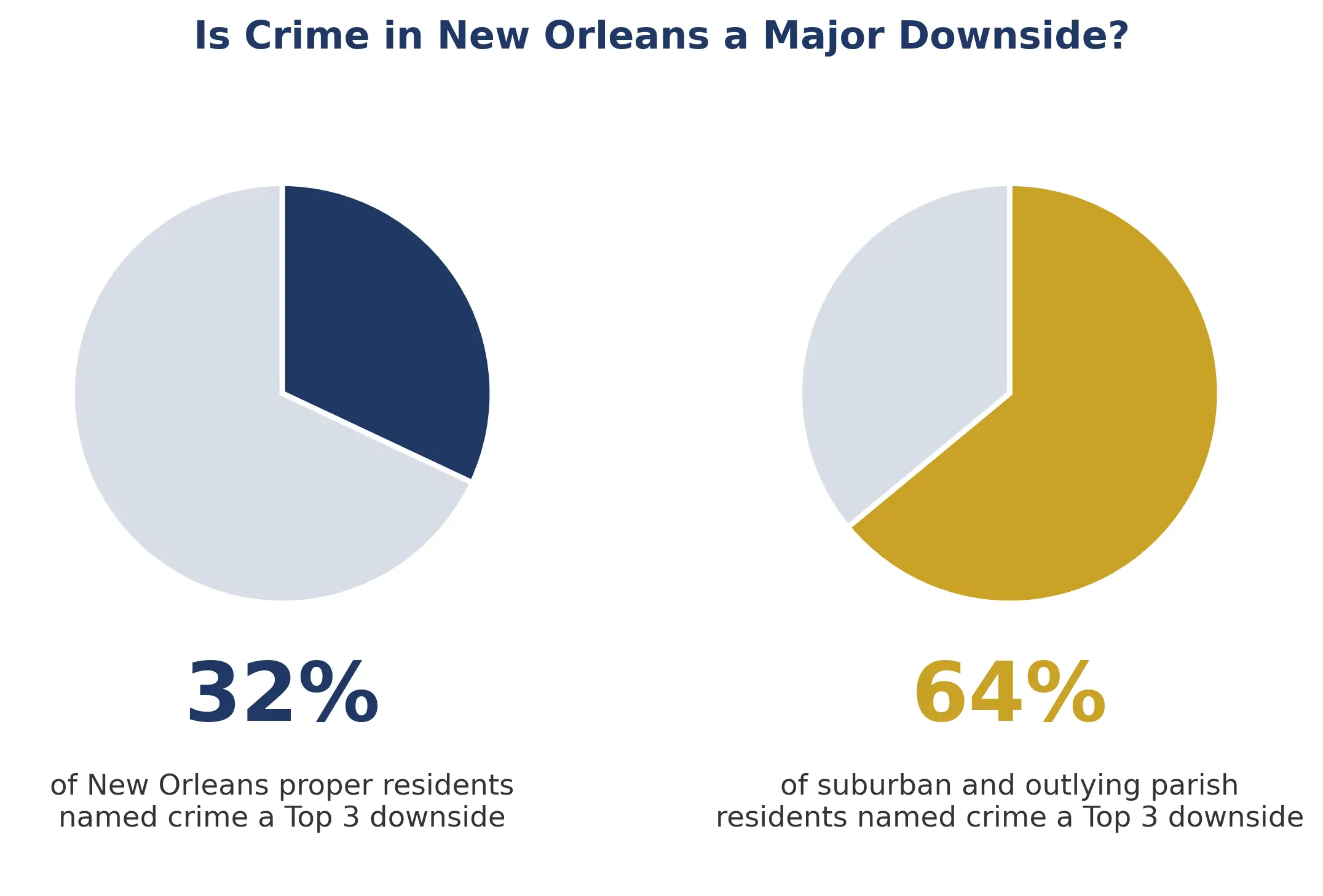
32%
of New Orleans proper residents named crime a top-three downside.
64%
of suburban and outlying-parish residents named the same thing.
People who live in New Orleans proper were half as likely to name crime a top downside as people in the suburbs and outlying parishes. 32% versus 64%. Read that again. The worry about the city’s crime is strongest among the people who don’t live in it. Meanwhile, both groups recommend the area at nearly the same rate, and both love the same things: food, festivals, culture. Our takeaway for you? The culture is metro-wide. Pick your address based on real trade-offs like commute, schools, flood zone, and yard space. Not fear, and not FOMO.
One more note on the Northshore, because it earned it. It sits across a 24-mile causeway, it runs quieter, and it’s honestly a different lifestyle. It still pulled 22% of the consider-first votes and the most #1 votes as a place to raise a family. The commute is the price of admission. Plenty of locals think it’s worth it.
Weather, Hurricanes, and Flooding: What New Residents Should Know
The Summer Test
Figure 14
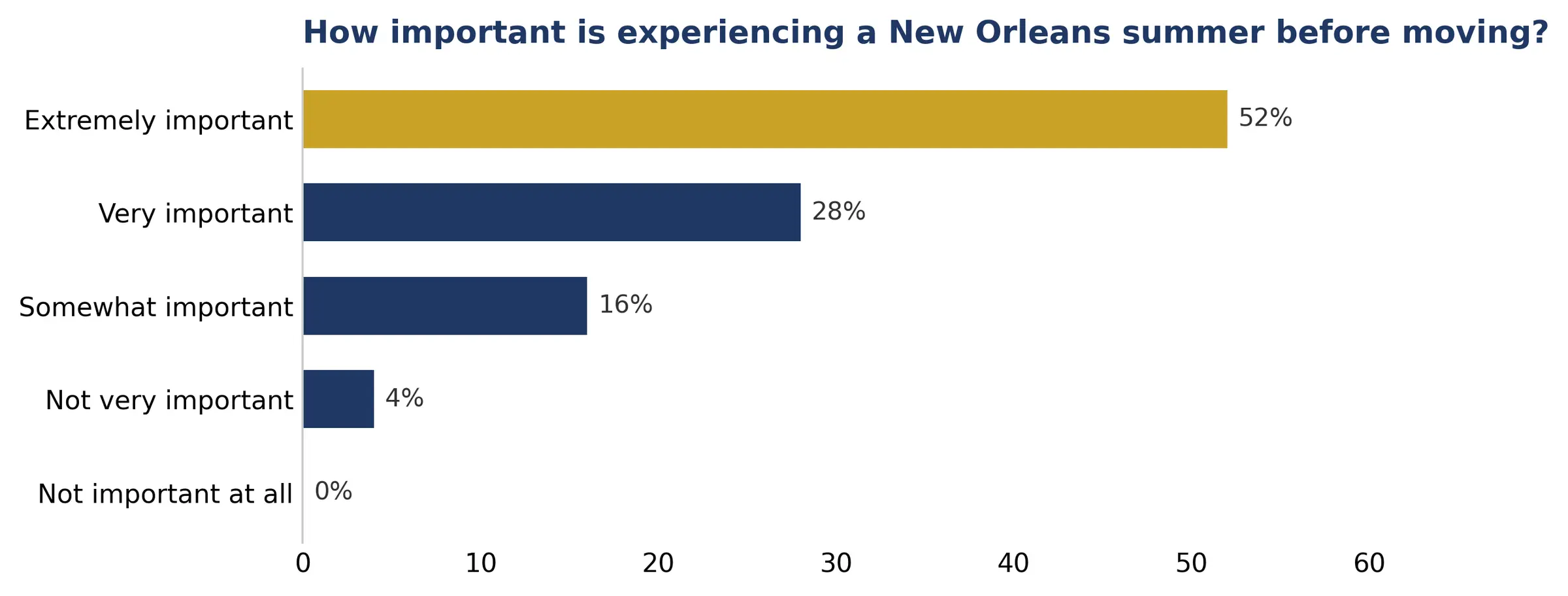
80% of locals say it’s extremely or very important to experience a New Orleans summer before you commit to moving here. Not one single respondent said it doesn’t matter. Zero. The heat also dominated the open-ended answers more than any other warning, and locals only disagree on one thing: whether you ever get used to it. 28% say your body acclimates. One respondent fired back:
“The heat is unbearable and you will NEVER get used to it.”
Our advice? Date the city in July before you marry it. Then decide.
How Locals Actually Handle the Heat
Figure 15
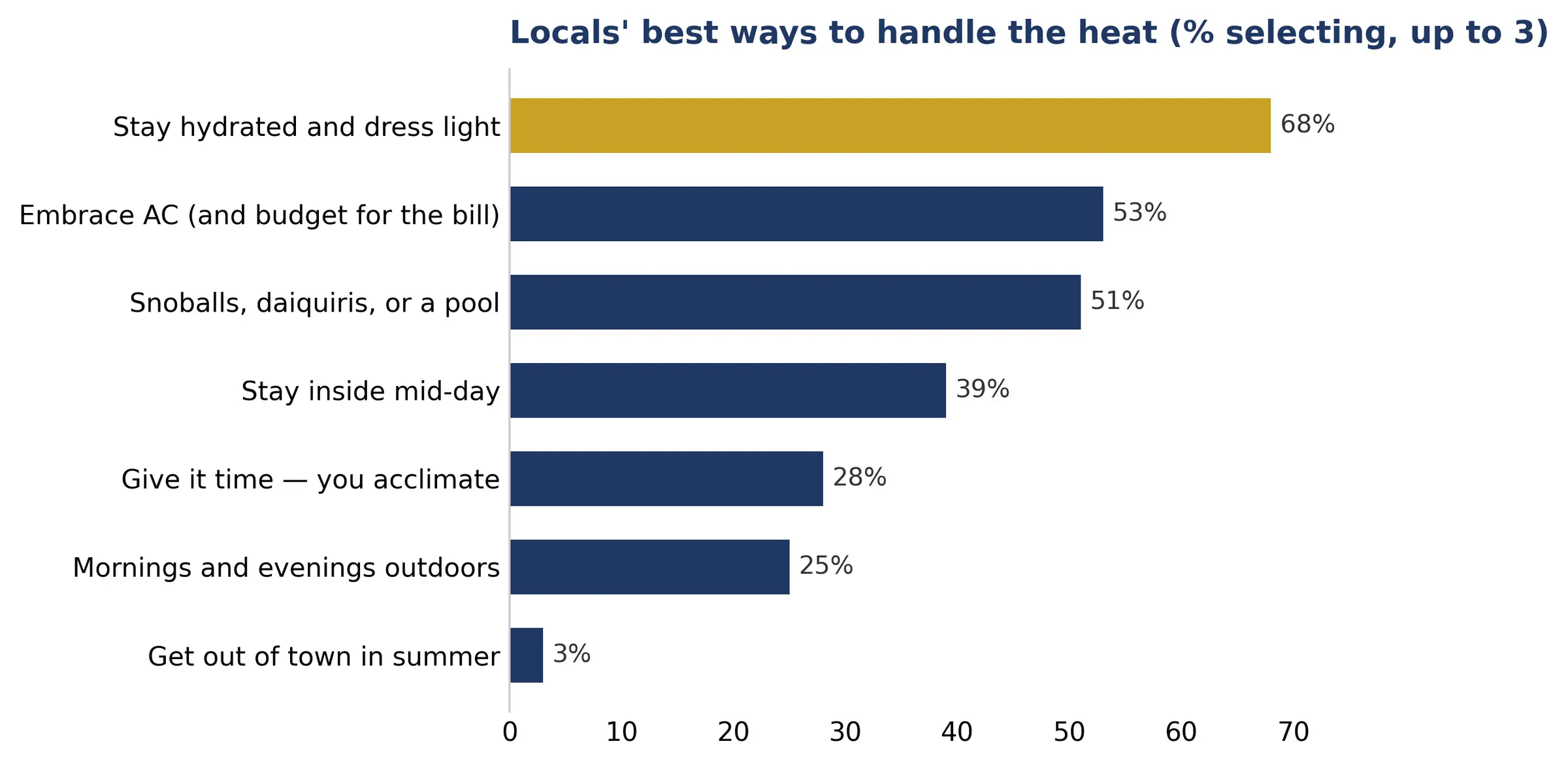
Their top three moves: stay hydrated and dress light (68%), embrace the AC and budget for the bill (53%), and cool off with snoballs, daiquiris, or a pool (51%). Only 3% said get out of town for the worst of it. Locals stay and sweat it out together, ideally within walking distance of a snoball stand. When in Rome.
Hurricane Season, According to People Who’ve Lived It
Figure 16
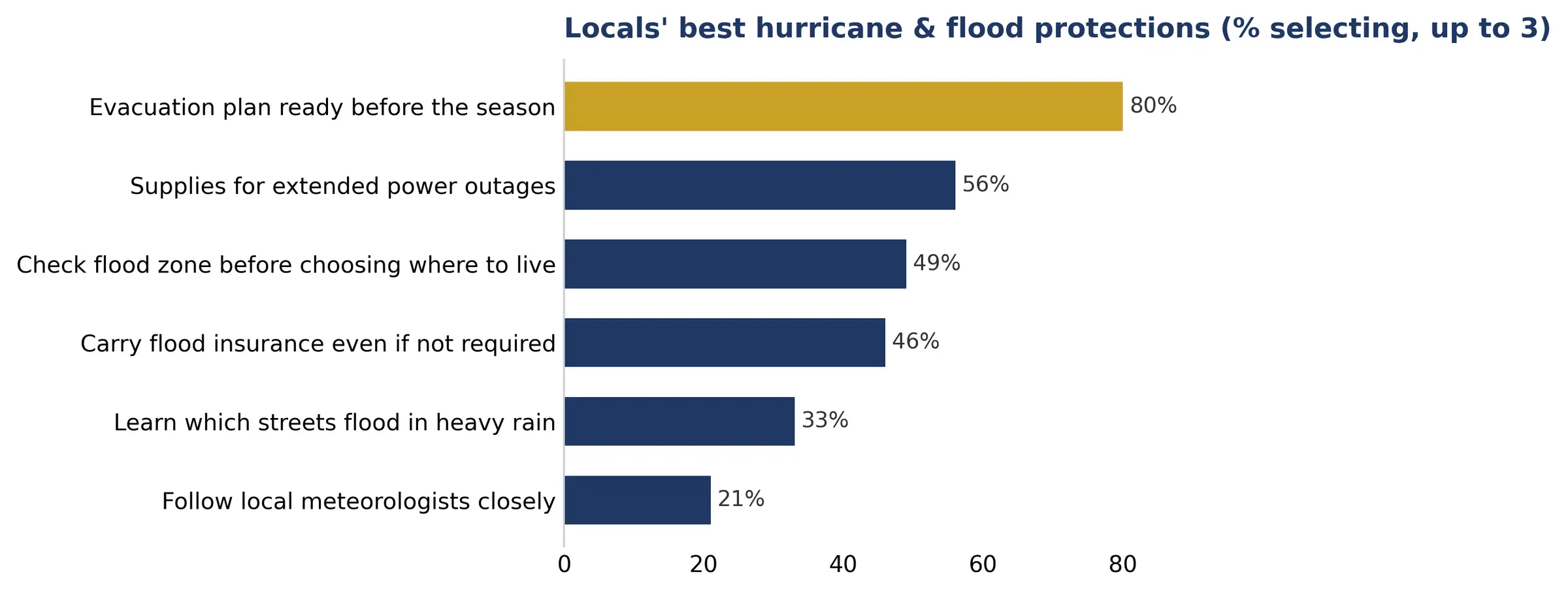
We asked for the best ways to protect yourself, and locals didn’t hedge. Have an evacuation plan ready before the season starts. 80% named it. Route, destination, go-bag, done. After that: keep supplies for extended power outages (56%), check the flood zone before you choose where to live (49%), and carry flood insurance even when nobody makes you (46%). A third of locals added the single most New Orleans piece of advice in this entire guide: learn which streets in your neighborhood flood in heavy rain.
And one respondent’s warning deserves its own paragraph:
“A tropical storm can do as much damage as a hurricane.”
The flood risk here isn’t just about named storms. A regular stalled thunderstorm can put streets underwater in an afternoon. Now you know why locals rank flood risk above housing cost.
Mark the calendar: hurricane season runs June 1 through November 30, so build your plan before June, not during your first cone of uncertainty. The city’s official prep hub is NOLA Ready for evacuation info and alerts, and you can look up any address’s flood zone through FEMA’s Flood Map Service Center. Bookmark both before you house-hunt, not after.
Sources: NOLA Ready · FEMA Flood Map Service Center
What to Do Before Moving to New Orleans: The Local-Approved Checklist
Before you sign anything
- Visit in summer, June through September, before you commit. It’s the local litmus test, and 80% of them insist on it.
- Look up the flood zone and elevation of any address you’re considering. Then visit the block during or right after a hard rain. Trust us.
- Get insurance quotes before you sign anything. Homeowners or renters, flood, and auto. These are the costs locals say you’ll underestimate.
- Rent before you buy, and visit the neighborhood in the evening first. Both came straight from our respondents.
- Have kids? Research specific schools, not just neighborhoods.
- Line up work before you arrive if you can. A quarter of locals say don’t come without it. Or land with $7,500 to $10,000 saved.
- Build your hurricane plan in your first month. Evacuation route, go-bag, outage supplies.
- Book movers and storage early if you’re arriving between January and June. You’re competing with festival season and every spring mover in the metro.
Self Storage in New Orleans
Almost every New Orleans move has an awkward gap in it somewhere. The lease that ends before the next one starts. The closing that slips a week. The gorgeous historic apartment with exactly zero closets. The renovation that kicks off the day your truck arrives. A short-term storage unit is the local workaround, and in this climate, climate-controlled matters more than it does in most cities. The same heat and humidity locals warned you about all through this guide is just as rough on your furniture, electronics, and anything made of wood or fabric.
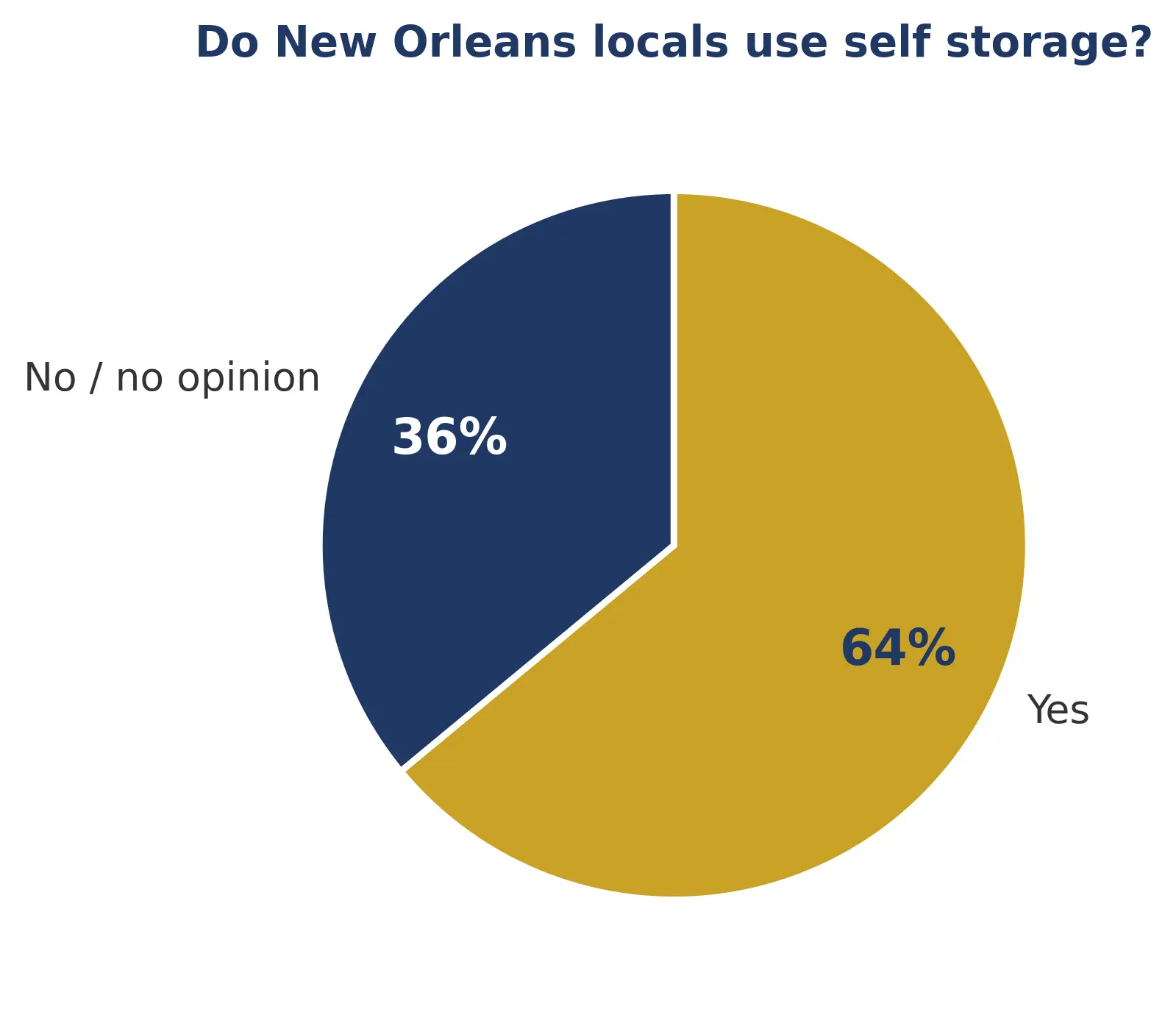
So, do New Orleans locals use self storage? 64% do, or at least had a favorite ready to name when we asked. Just 36% said they don’t use it or had no opinion. In a region that moves, renovates, downsizes, and rides out hurricane season on a rolling basis, storage is simply part of the logistics of living here. If you’re about to move, you’re probably about to join the 64%.
Figure 17
The Storage Center has been part of the Gulf South since 1986, with 70+ facilities across Louisiana and the region, including locations serving the Greater New Orleans area. You’ll find climate-controlled units, 24/7 video surveillance, and access from 6 AM to 9 PM, seven days a week, which helps when moving day runs long. It always runs long. If you’re planning your move, browse storage units in New Orleans and give your stuff a cool, dry place to wait while you find the right block. Rain-tested, of course.
Planning a move into the metro?
Climate-controlled units, 24/7 video surveillance, and access from 6 AM to 9 PM, seven days a week, which helps when moving day runs long. It always runs long.
Browse storage units in New OrleansNew Orleans Local Favorites: The 2026 Best-Of List, Voted by Locals
This is the fun part. We gave locals the categories, they gave us the winners, and we’d put this list up against any critic’s. No algorithms, no sponsored placements, just 100 residents voting on where they’d actually send you. Screenshot it, share it, argue with it. That’s what it’s for.
- Gold: locals’ #1 pick
- Silver: runner-up
| Category | Locals’ #1 pick | Share | Runner-up |
|---|---|---|---|
| Best burger | Port of Call | 45% | Bub’s NOLA (14%) |
| Best pizza | Fat Boy’s Pizza & Reginelli’s (tie) | 24% each | Mid City Pizza (15%) |
| Best po’boy | Parkway Bakery & Tavern | 28% | Guy’s Po-Boys (22%) |
| Best date night | Commander’s Palace | 42% | Bacchanal (13%) |
| Best family restaurant | The Camellia Grill | 31% | Juan’s Flying Burrito (15%) |
| Best live jazz | Tipitina’s | 34% | Preservation Hall (13%) |
| Best family activity | Audubon Zoo | 35% | City Park / Carousel Gardens (20%) |
| Best crawfish month | April | 38% | May (25%) |
Best burger: Port of Call ran away with it at 45%, more than the next three finishers combined. That’s the French Quarter institution where the burger comes with a baked potato instead of fries, and apparently the city has decided that’s correct. The write-ins are worth your attention too: locals took the time to type in Bud’s Broiler, Lee’s Hamburgers, Lil’ Dizzy’s, Ground Pati, New Orleans Hamburgers & Seafood, and Original Slap Burger. When someone bothers to write in a burger joint by hand, that’s a recommendation with feeling.
Best pizza: A genuine tie at the top. Fat Boy’s and Reginelli’s each took 24%, with Mid City Pizza close behind at 15%. Pizza was also the most write-in-happy category in the survey, and the ballot stuffing was gloriously local: Tower of Pizza, Mo’s Pizza, Vieux Carré Pizza, Zee’s, and Pepperoni Ray’s all earned handwritten votes. Translation: New Orleans pizza loyalty runs neighborhood by neighborhood, and everyone’s corner spot is the best one.
Best po’boy: Parkway Bakery & Tavern took the crown at 28%, with Guy’s Po-Boys a strong second at 22%, a fantastic showing for a tiny Magazine Street lunch counter against Parkway’s national reputation. The write-ins came in hot here too: Mother’s, Johnny’s Po-Boys, Short Stop, and Bear’s all got votes. And one respondent gave the most honest answer in the entire survey: “any place that has a lunch line.” That person gets it.
Best date night: Commander’s Palace, and it wasn’t close. 42% of locals picked the Garden District landmark, which has been closing deals and anniversaries since 1893. Bacchanal’s backyard wine garden took second at 13%, the scrappy Bywater counterpoint to Commander’s white tablecloths. Write-in votes went to Shogun, Morrow’s, and New Orleans Food & Spirits, proof that a great date night here doesn’t require a jacket.
Best family restaurant: The Camellia Grill at 31%, because nothing entertains a kid like counter seating, bow-tied waiters, and a chocolate freeze. Juan’s Flying Burrito took second at 15%. The write-in story here belongs to Copeland’s, which three separate respondents typed in unprompted, along with votes for Casa Garcia and Velvet Cactus. Three independent write-ins for the same restaurant is a signal worth hearing.
Best live jazz: Here’s a fun upset. Tipitina’s won at 34%, more than doubling Preservation Hall’s 13%. Tourists queue around the block for Preservation Hall, and it’s wonderful. But when locals want live music, they head Uptown to Tip’s. Not a single person wrote in another venue, which in a city with this much live music is its own kind of consensus.
Best family activity: Audubon Zoo at 35%, with City Park and Carousel Gardens second at 20%. One respondent wrote in Joe Brown Park and Nature Center out in New Orleans East, a genuinely under-the-radar pick that most relocation guides have never heard of. Now you have.
The Festival Question, and a Tie at the Top
Figure 18
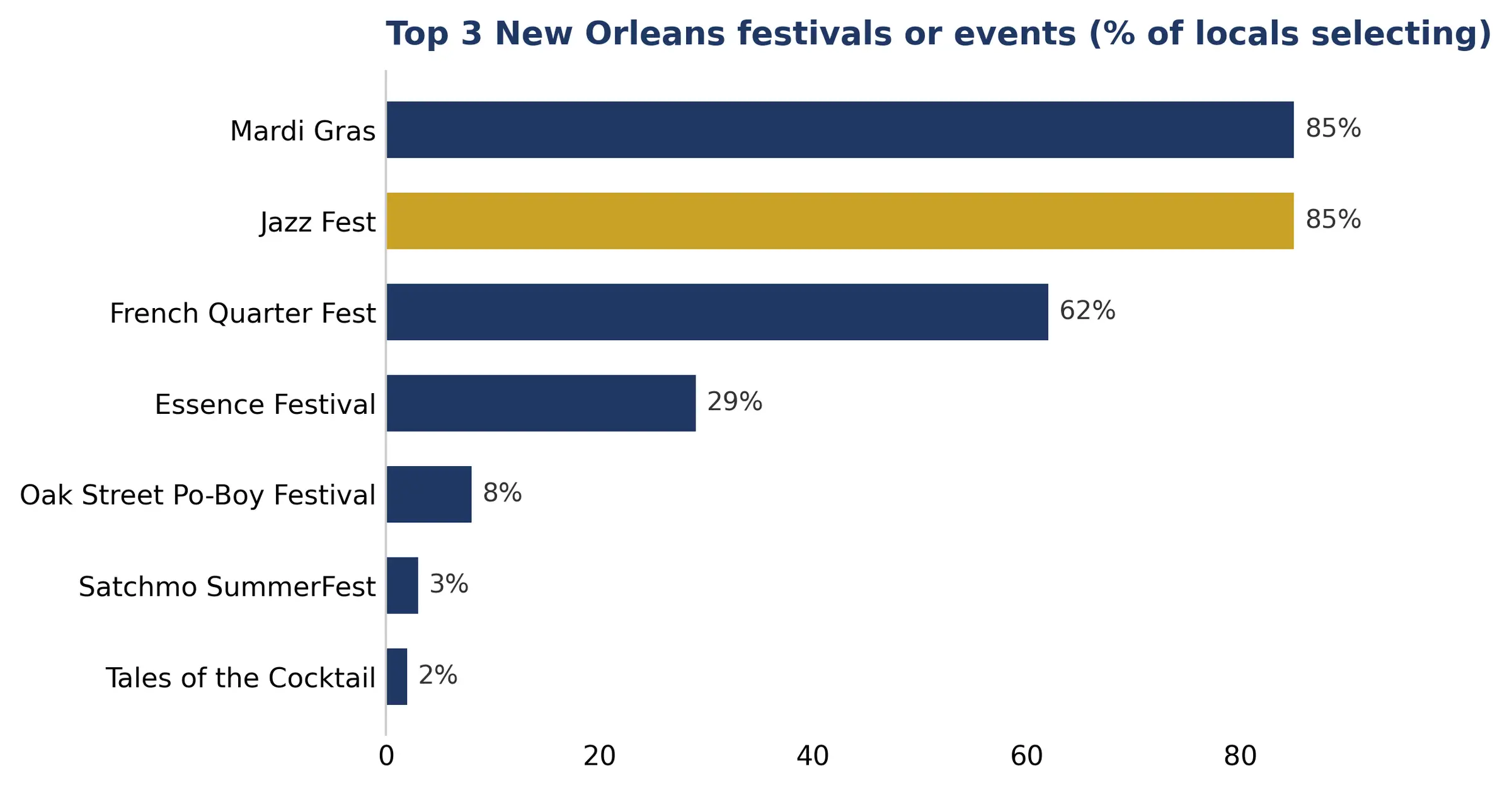
Jazz Fest tied Mardi Gras. 85% each. Let that sink in. The whole world knows Mardi Gras, but locals hold Jazz Fest just as close, with French Quarter Fest a strong third at 62%. If you move here and only plan around February, you’re doing it half right. One nostalgic respondent even wrote in Voodoo Fest. We miss it too.
Weekends: What Living in New Orleans Actually Looks Like
Figure 19
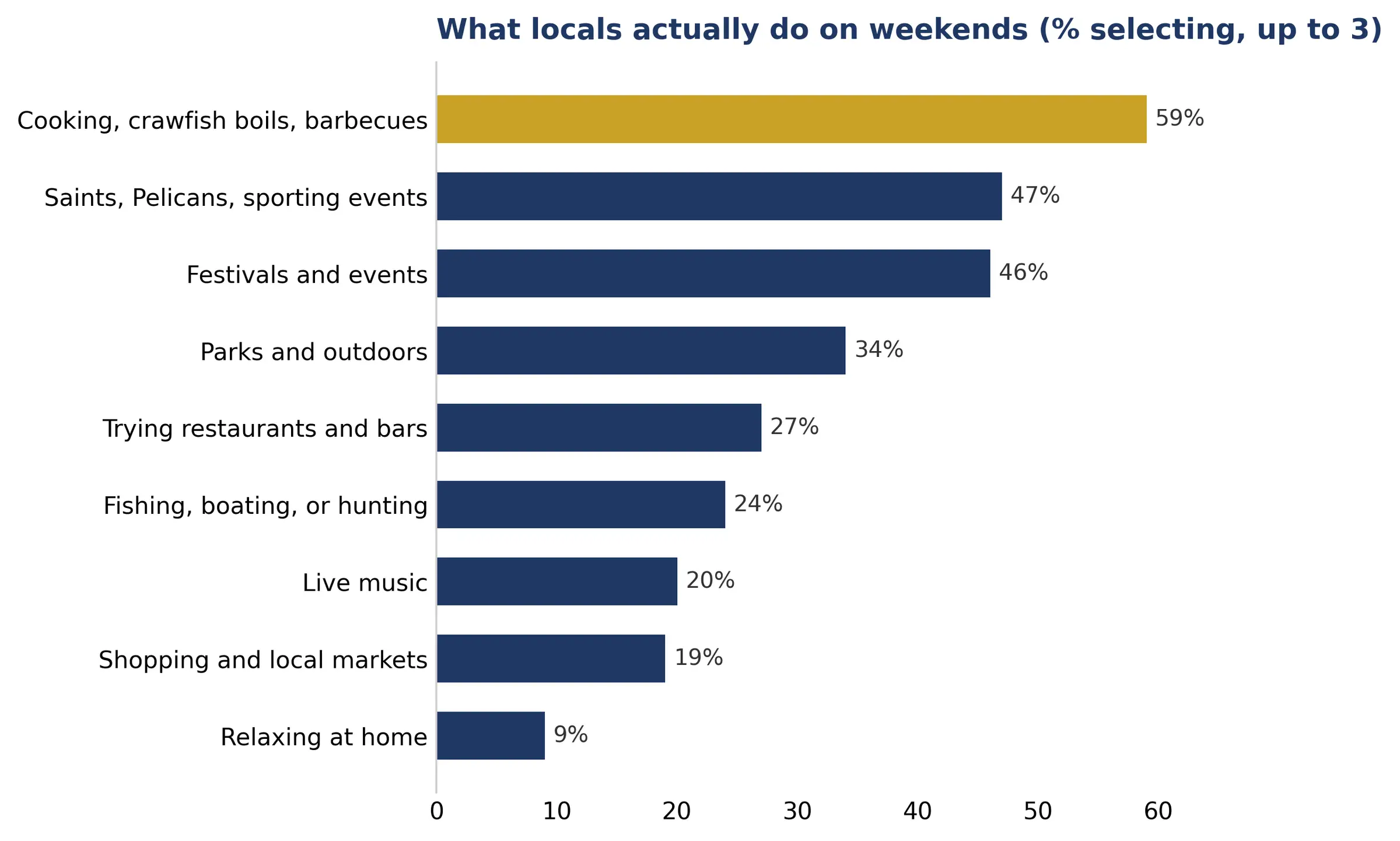
And here’s our favorite finding in the whole survey. We asked locals how they actually spend their weekends, and the #1 answer wasn’t festivals. It wasn’t Bourbon Street. It was cooking, crawfish boils, and barbecues with family and friends, at 59%, beating Saints and Pelicans games (47%) and festivals (46%). The real New Orleans weekend happens in a backyard, around a propane burner, preferably in April. That’s the month 38% of locals crowned best for a boil, so time your first invite accordingly. And yes, you’ll get invited. This city adopts people. Oh, and one respondent wrote in “Second Line” as their weekend answer, which might be the most New Orleans response in the entire survey.
What 100 Locals Wish Someone Had Told Them Before Moving Here
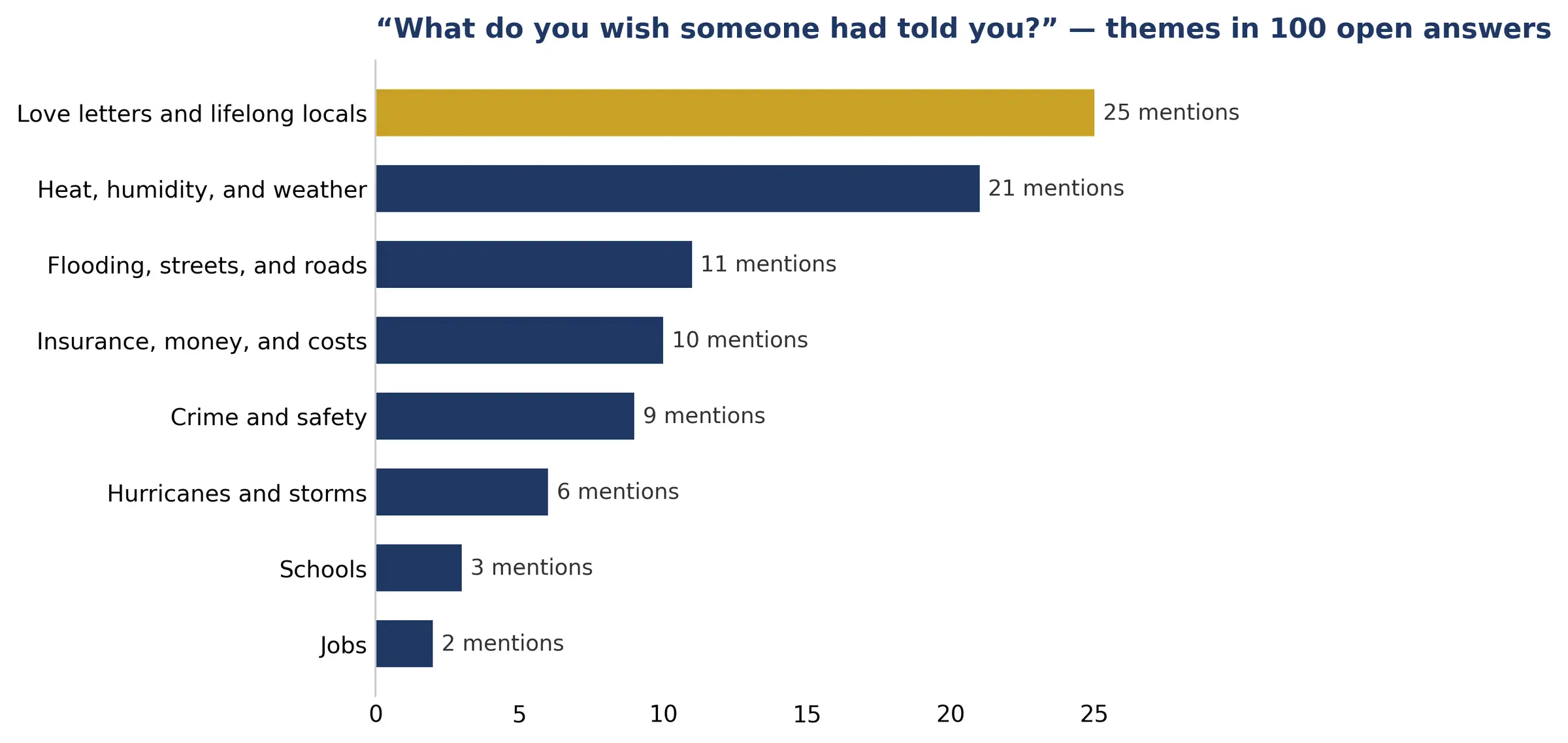
We ended the survey with one open question and zero prompts: what’s the ONE thing you wish someone had told you before living in or moving to New Orleans? A hundred people, a hundred answers, and they sorted into themes fast.
Figure 20
- Heat, humidity, and weather: “The heat is unbearable in summer and we have little season changes.” “You don’t get used to the heat!” “How much different the heat is from Florida.”
- Flooding and streets: “Learn what streets flood in a heavy rain.” “I wish someone would’ve told me it’s flooded a lot.” “The potholes are ridiculous.”
- Insurance and money: “How expensive home insurance is.” “You need a nice amount of money to live here.”
- Crime and safety awareness: “The crime in some of the areas.” “Safe and unsafe places to go.”
- Hurricane reality: “A tropical storm can do as much damage as a hurricane.” “The stress and panic of worrying about hurricanes.”
- House-hunting wisdom: “Visit the neighborhood in the evening before purchasing the house there.” “Check the school districts before buying a home.”
But here’s the finding we didn’t see coming. The single biggest theme wasn’t a warning at all. A quarter of respondents, the largest group in the whole question, used their one open answer to say some version of “nothing,” “I was born here,” or a straight-up love letter. “You won’t want to ever leave.” “How beautiful the city is and its culture.” “Nothing. I just love it. No other or better place to be.” Anonymous survey. Every chance to vent. And more locals defended this city than warned about any single thing in it. If you’re looking for the real case for moving to New Orleans, it’s that.
“You won’t want to ever leave.”
Frequently Asked Questions About Moving to New Orleans
Ten questions, answered from the survey.
Is New Orleans a good place to live?
Most locals say yes. 57% of the 100 Greater New Orleans residents we surveyed in 2026 would recommend moving here, and only 3% said definitely not. They love the food, festivals, culture, and community. They’re honest about the heat, hurricanes, insurance costs, and infrastructure.
What is living in New Orleans really like?
Ask the 100 locals we surveyed. Festivals are part of everyday life (30% called that their biggest surprise), weekends revolve around crawfish boils and cooking with family (59%), and the food tops everything (81% named it among the best things about living in New Orleans). Balance that against real heat, hurricane season, and insurance costs, and you’ve got the honest picture: a city that demands a little logistics and repays it in culture.
Is it expensive to live in New Orleans?
Locals split three ways: 38% call it affordable, 30% average, 31% expensive. Base housing can run below the national average, but insurance evens the score. Flood, homeowners, and auto insurance were the three costs locals most often said newcomers underestimate. One useful benchmark: C2ER’s 2025 annual Cost of Living Index puts New Orleans at 113.2, where 100 is the average across participating U.S. urban areas, about 13% above that benchmark overall. (C2ER data via McNeese Drew Center)
How much money should I save before moving to New Orleans?
Locals who gave a number most often said $7,500 to $10,000 or more. And 26% said don’t move here without a job already lined up.
What are the best neighborhoods in New Orleans?
Locals say prioritize safety and flood risk over everything, including price. For a first landing spot, they point newcomers to Metairie and the Northshore most often. Inside the city, Mid-City and Lakeview led, with Uptown and the Garden District close behind.
What’s the best area of New Orleans for families?
Metairie scored best overall in our family ranking, Lakeview came second, and the Northshore drew the most first-place votes. Locals’ consistent advice: research individual schools, not just neighborhoods.
Do you need a car in New Orleans?
Depends on your address. The Marigny (Walk Score 96), Uptown (88), and Mid-City (81) support a walkable, bikeable, streetcar-connected life. The citywide average is 58, though, so for most addresses you’ll still want a car.
What should I know about hurricanes before moving to New Orleans?
Locals’ playbook is clear: build an evacuation plan before the season starts (80% named it their top protection), keep outage supplies, check any address’s flood zone before signing, and carry flood insurance even where it isn’t required. And remember their warning: a tropical storm can flood streets as badly as a hurricane.
When is the best time of year to move to New Orleans?
Practically? October through April. You’ll skip peak heat and the core of hurricane season. But locals are nearly unanimous that you should experience a summer before committing, so visit in July even if you move in November.
What’s the best month for a crawfish boil?
April, says 38% of locals, with May second at 25%. Plan your first boil accordingly, and don’t be the person who suggests August.
How We Built This Guide (Methodology)
This guide is based on “Living in New Orleans,” an original survey of 100 adults living in the Greater New Orleans area, conducted in September 2026. Respondents were screened for residency in the Greater New Orleans area (New Orleans, Metairie, Kenner, the West Bank, the Northshore, and surrounding parishes) and passed a local-knowledge screening question. 66% of respondents grew up in the area or returned to it, and 34% moved here. 81% have lived in the area more than 15 years. Percentages for select-up-to-3 questions reflect the share of respondents choosing each answer, and ranking questions report average rank position. Survey data was supplemented with publicly available sources cited throughout. The survey was commissioned by The Storage Center, a family-owned storage company serving Louisiana since 1986.
About the Author

Take it with you
The whole guide, formatted to print
Every chart, both tables and the local-approved checklist, in one file.